
Pi-Ble Project
ㅤThe goal of this project was a simple wish to create a tiny computer hidden inside a book. This goal was based on a realization that I had a lot of little computer parts (mini keyboard, Raspberry Pi 4, mini mouse, micro SD card).
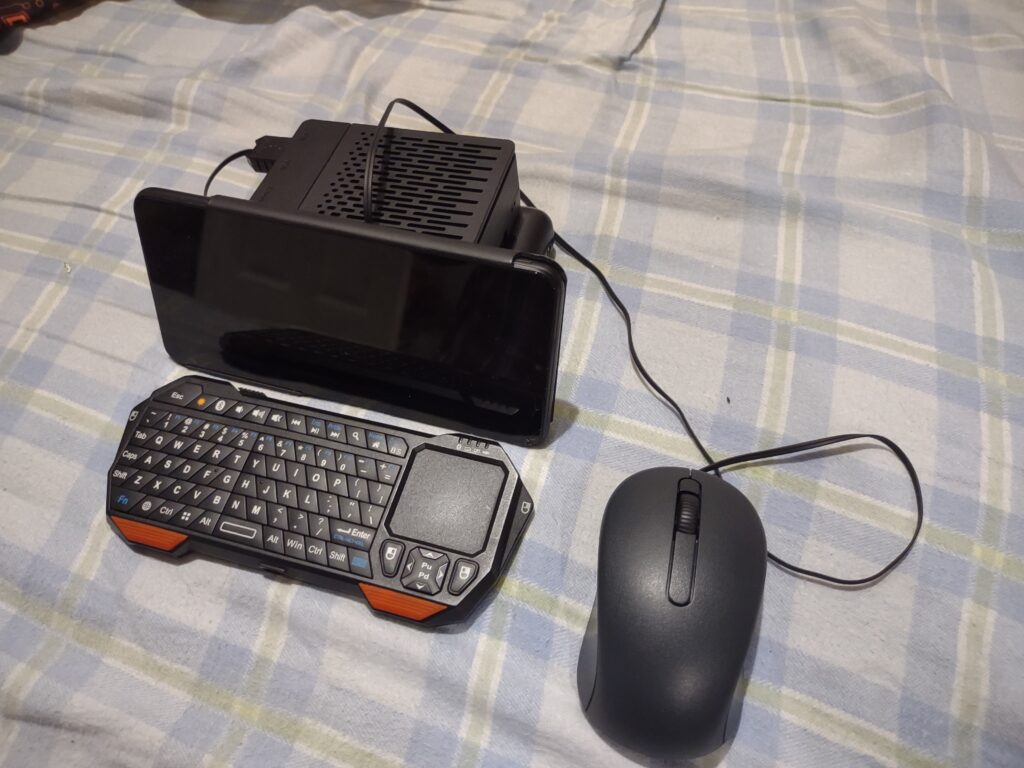
ㅤI had the opportunity to put all of this together when I joined Hope College’s Formula SAE team. Thay have a “Freshman Design Project/Competetion, ” so me and a friend teamed up to create the Pi-Ble, named so because we used a thick bible-study guide and the computer we used was a Raspberry Pi.

ㅤThe goal we had was to get Windows 10 functioning and playing Portal. We got started in parallel: working on booting Windows 10 at the same time we hollowed out the book. Both turned out to be difficult as Windows is not usually compatible with Raspberry Pi, and our X-Acto knife wasn’t proving as efficient as we hoped.
ㅤThrough the process we discovered the project known as WoR (Windows on Raspberry) and began to use that program to boot windows onto our Raspberry Pi. When that still wasn’t working, we found that booting PiOS (the operating system built for Raspberry Pi’s) and from there booting Windows using WoR did work! Now, unfortunately we are not able to connect with the internet when using WoR booted Windows 10, and not even with the Wi-Fi dongle we got could fix that problem.
ㅤThe last hurdle on the software side was Portal. From Windows 10, it was fairly simple to download STEAM through an external Harddrive and download Portal. From there you would think it was a simple as opening the game, but the Pi with Windows just couldn’t handle it. The solution we found was to use STEAM’s Remote Play feature. So Portal was running on my laptop, but we watched it and controlled it on the Raspberry Pi. It was a slide show, but it worked!

ㅤHollowing the book proved very difficult. We jumped from an X-Acto knife to a Dremel with a metal brush to cut away the page insides. I believe we tried several other knives, and dremel tools. Eventually, about half-way through, we tried a new X-Acto knife, and BOY WAS THAT OLD BLADE DULL. We cut the remaining pages like butter!
ㅤ

ㅤAll that was left was to put it all together. I modeled all the parts in SolidWorks, using a caliper to measure it accurately. I designed a box to be 3D printed to place all the computer parts in to separate it from the pages. This also would give the pages a solid surface to be glued to, so the pages don’t fall apart. The model also was designed to hold the parts in place. Unfortunately, when we attempted to place all the parts in the way they were modeled, the wires (especially the HDMI) took a lot more space then was guessed.
ㅤ The power supply had to taken apart to make space, and was placed on the short side of the box. You can see our completed product below! I was told recently that we would have won, if it was a real competition!

